Wednesday, December 12, 2018

Husky Brings to Market Two Environmentally-Friendly Products to their Family of Products at the same time that their Technical Service Engineer adds to his Family

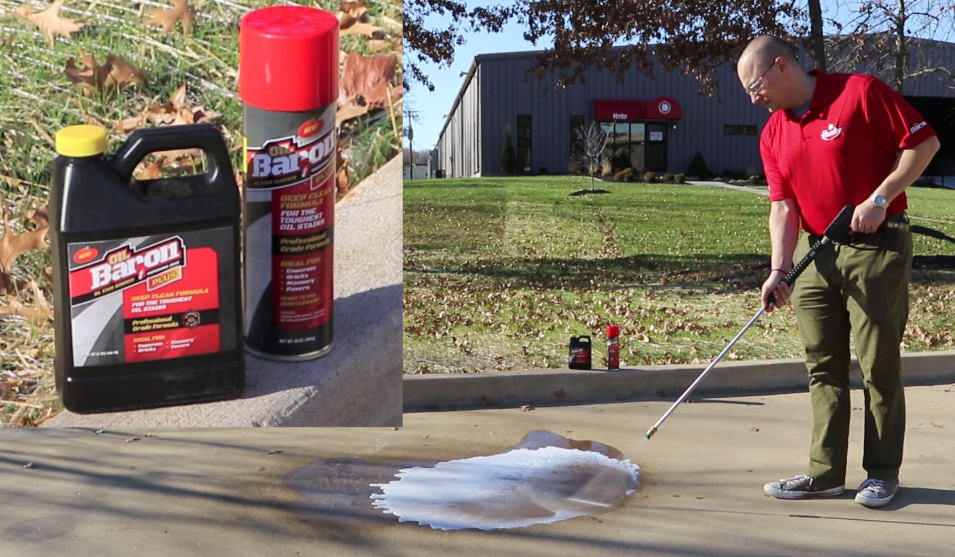
This article about Oil Baron and Oil Baron Plus was written and shared with a variety of news outlets by American Media Distribution.


Husky, that already has a fine line-up of complimentary products, just
added two more: Oil Baron and Oil Baron Plus. Like a student who loves
chemistry class, Paul Nilsen, Husky’s Technical Service Engineer assigned
to these new products, is excited to demonstrate how they work using
something called microbial action. He, along with Brad Baker, Husky’s
Executive Vice President, are nothing short of giddy when they talk
about the two new Oil Baron products.

Paul could not wait to squeeze some oil onto a granite sample board and
then add a diluted amount of Oil Baron. The mixture started to bubble
and pop. Carbon Dioxide was released into the air and water remained.
When the bubbling stops, no special hazardous waste disposal is
required for what was left over. A simple concept with far-reaching
ramifications. Oil Baron is used to clean unsightly, unsafe or hazardous
messes using floor scrubbers, pressure washers or mops. The product is
also great for use in an Emergency Spill kit -- because it makes a gas spill
non-flammable very quickly.

As we moved on to the Oil Baron Plus product, Paul coolly checked his
phone. He had an important reason to stay connected: his wife was
about ready to give birth to their child. Although he was allowed go
home to be with her, he wanted to finish the demonstration albeit at a
record pace.

Paul explained that Oil Baron Plus removes the toughest hydrocarbon
(oil, gas/diesel, tar) stains on most hard, industrial surfaces. Paul warned
that one must be careful when using this product as it will turn an asphalt/gravel road into just gravel and, if it gets on your car, will dissolve
the paint.

Key market segments for these products include the petroleum
dispensing industry (gas stations, convenience stores, truck stops,
petroleum product distributors, airports, etc.) and the automotive repair
industry (car repair businesses, truck/auto dealers or service centers, oil
change shops, etc.) and any other commercial/residential application
where petroleum messes are an issue.

More detailed information is at the company's web
explanation videos and technical specifications.

Husky Corporation is a leading manufacturer of equipment for the
petroleum dispensing industry, which has been growing organically and
through acquisitions of companies and products in related industries and
has been in business for also 70 years, based now in Pacific, Missouri.

Congratulations to Paul and his wife who, a short time after our
interview, brought a healthy baby girl into this world. A world that now
contains a way to turn spilled hydrocarbons into harmless carbon dioxide
and water. Someday she will be proud of her Daddy for, in his own way,
helping to make the world a cleaner place

Wednesday, December 5, 2018

Husky Corporation in the News: St. Louis Business Journal

A company that started in a basement in 1947 has achieved another milestone. Husky Corporation, which manufactures fuel nozzles and other equipment related to the petroleum industry, has reached $50 million in annual sales. The St. Louis Business Journal story about this item is available at this link - which will require a subscription to view in its entirety.

https://www.bizjournals.com/stlouis/news/2018/11/29/st-louis-nozzle-company-hits-50-million-in-sales.html

Company president Grenville Sutcliffe told reporter Greg Edwards revenue had increased from about $40 million two years ago. When he joined the company in 1971, revenue totaled $375,000.

Edwards wrote this passage in the article: Husky, founded in 1947 by Sutcliffe’s parents, provides the nozzles and parts to most of the companies that own gas stations in St. Louis, and provides them worldwide to meet the specifications required in each country. “Any place in the world that has cars needs our products,” Sutcliffe said. The company ships about 2 million parts a year, he said.

The revenue information was part of an in-depth interview for an upcoming 'St. Louis Character' feature on Mr. Sutcliffe in the St. Louis Business Journal. Sutcliffe recalled in another recent interview some of his recollections about how the company started by his parents really got rolling.


Husky has 170 employees and manufacturing space of 84,000 square feet in Pacific, Missouri.

Tuesday, November 6, 2018

The Road to Year-Round E15 in the United States

President Trump's announcement that year-round sales of gasoline blended with up to 15 percent ethanol would be approved by the administration has been a long-standing goal for U.S. corn producers. The U.S. Environmental Protection Agency (EPA) needs to take the required steps to formalize the announcement, which is a process that could take an undetermined amount of time. An article published by Agriculture.com summarizes what that may entail.

Gasoline retailers interested in offering E15 probably have a bit of time to plan for the transition.  About 2,000 U.S. stations currently offer E15, which is less than two percent of all outlets. Present rules limit sales to summer months under the Reid Vapor Rule, which the EPA uses "to reduce evaporative emissions from gasoline that contribute to ground-level ozone and diminish the effects of ozone-related health problems." The president's announcement would make E15 exempt from the Reid Vapor Rule. Experts say there's little vapor pressure difference when compared to E10.


The petroleum dispensing industry has been getting ready for this change for a number of years. Fuel nozzle valves manufactured since April 30, 2015 have been covered by updated UL standards.  UL2586 applies to nozzle valves that dispense gasoline containing up to 10 percent ethanol, while UL2586A applies to nozzles valves with concentrations of up to 85 percent ethanol.

Husky Corporation participated in an article for the PEI Journal that lays out the specifics of the new standards dealing with enhanced ethanol blends. We hope you find it helpful in planning your operations if you would like to market E15.

An article in CSP daily notes that "The EPA approved the use of E15 in model-year 2001 and newer light-duty vehicles. Today, this represents more than 92 percent of registered cars and trucks, according to the (Renewable Fuels Association) RFA." The RFA provided the information to counter concerns by some that E15 could damage vehicles and void warranties.

Monday, October 1, 2018

RS Gas Spring Pressure Adjustment Tool

The Roman Seliger SGA Loading Arm is a safe and easy arrangement for the transfer of liquid and gas products to tanker cars, tanker trucks, and vessels. These units are available with special spring or gas-operated mechanisms to raise and lower the arm with minimal effort to easily facilitate its use.


The gas springs arrive from the factory purposely over-filled so that the end user can fine-tune the pressure for each application. That requires a number of steps that need to be carefully followed.

Engineers as Husky Corporation have designed a valve adjustment tool (P/N 013095) to make the procedure easier than it had been previously.


Contact Husky Corporation to learn more about this tool and to get detailed instructions that must be followed to safely make these adjustments. Husky is the authorized U.S. Representative for Roman Seliger SGA Loading Arms and couplings.

Friday, September 28, 2018

BJE 007 Mission: Making a Great Impression

BJE Lube and Oil Products customer Automotive and Carwash Equipment Services (ACES) makes the installation of 007 Tank Alarm systems (for overflow detection of oil, waste oil, diesel fuel, antifreeze, water and other fluids with a high flash point) shine with a combination of practicality and innovation.

BJE’s 007 Tank Alarm is an alarm that is commonly used in waste oil applications to avoid tank overflows. It is sold with the 007 SV (solenoid valve) or 007 SVT (solenoid valve with timer) which shuts off the flow of oil to a tank when the alarm goes off to avoid over flows. The 007 can also be set up to detect low fluid levels, in applications where it’s important to avoid untimely shortages.

ACES Senior Lead Technician Chris Watford is a self-described “aesthetics guy” who set out to find a way to “hide the wires and clean up the look” of the 007 tank monitoring system when installing them at customer locations. Many locations simply install the components on a wall near the tanks which leaves wires, conduit, power supplies and connectors exposed to the eyes and the elements. 
“It doesn’t take long for waste oil to get into places it doesn’t belong,” Watford said.

So, in 2013 Watford started tackling the problem by first eliminating the visible transformer wires of a 007 system in a hallway that was frequently viewed by the technicians at a car dealership.

Next ACES decided to further improve the look when they mounted both the 007 and the solenoid valves on diamond plate, which would then be affixed to a wall near electrical power and the waste oil tanks.

“The way they have this set up, it looks really clean and professional,” said Tony Aumiller East Coast Sales Manager for BJE and parent company Husky Corporation.

Practicality led to the next iteration of what could be called 007 system equipment boards. Watford developed a simple hinge bracket, so technicians could swing the diamond plate away from the wall to work on wires, conduits, connections and hoses. Now all wiring is removed from view but can be accessed when needed.  


“It was all to clean up the look and hide the wires. But then we started making it easier for people to work on the units,” Watford said.

Watford says the reaction from customers, which include auto dealerships and large fleet operators, has been very positive. He has received several certifications to support his work from the Petroleum Equipment Institute (RP600, RP700, RP800 and RP1100) that deal with the installation and operation of above ground tanks, fluid distribution systems at vehicle maintenance facilities, bulk storage tanks, and equipment that handles DEF.

“Everybody is very inquisitive about it. They want to know how it works and they always comment that it looks very clean, since there are no wires showing like the last one we might have installed for them,” Watford said.

The systems can be customized a bit with desired colors or based on the type of application. One example involves several 007 equipment boards that will be installed in a large distribution facility where the units will be affixed to a pump bracket attached to the wall. Yet the clearance still slows access to transformers, wire connections and other equipment for ready access. 
Contact Husky Corporation toll-free at 800-325-3558 or at sales@husky.com. Get more information about the BJE web site https://www.husky.com/bje.

Thursday, September 13, 2018

Black Knight and Red Fox: Cleared for Outdoor Duty


Ingress Protection testing is the process associated with determining the level of protection an enclosure provides against the elements. These intrusions can be many things including water, dust and other foreign objects. The IP Code, also known as the International Protection Marking, rates the degree of protection an enclosure provides. The IP Code has two digits. The first digit identifies the level of  protection from solid particles and the second digit indicates how much protection is provided against liquids.

Recently, a regulatory compliance lab completed Ingress Protection testing for two popular BJE liquid level gauges: Black Knight and Red Fox. Both of the units earned the rating IP53, certifying the internal mechanisms of these gauges are protected from dust and sprayed water. That means both of these gauges are now cleared for use in outdoor applications.


“The tests revealed no water entered the housing of Black Knight or Red Fox units when sprayed at angles up to 60 degrees, like that of a sustained rain storm,” said BJE Project Engineer Paul Pitney. “After eight hours of ‘dust storm’ exposure testing, the Black Knight experienced minimal dust incursion. It was significantly less than the IP standard allows and definitely not enough to interfere with the Black Knight’s operation.”

Recent design modifications fully enclosed the mechanism housing for both gauges. BJE engineers submitted the redesigned units for Ingress Protection testing to verify atmospheric elements like dust or rain would not interfere with their operation. The Black Knight mechanically measures decreases in levels of oil, waste oil, diesel fuel, antifreeze and other fluids with a high flash point in tanks up to 99 inches deep. The Red Fox keeps track of tanks with similar liquids when they are being filled up.

Contact a BJE customer service representative to learn more about the recently enhanced BJE Black Knight and Red Fox gauges at 800-325-3558.